
Idea
A music or audio creation app
Explore a sound-led identity for a focused recording, beat or sample tool.
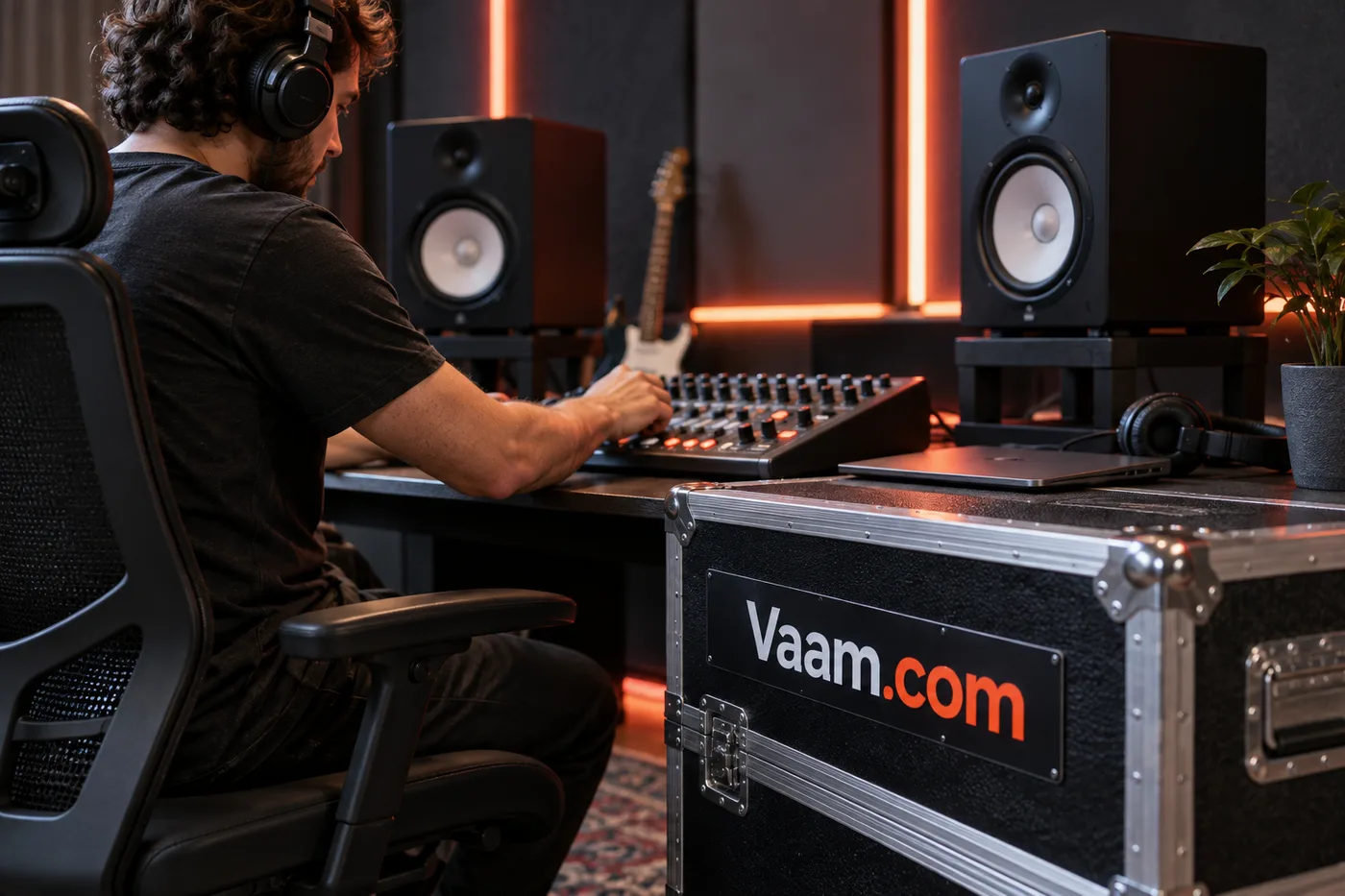
An audio creation product earns a place in someone’s routine by helping them finish a particular task. That might be capturing an idea before it disappears, shaping a sample or assembling a spoken recording. Vaam could be explored as the name of a focused tool in that space. The concept here is illustrative: it does not describe an available app, a catalogue of sounds or a community of existing users.
The name is short enough to try in an app icon label, a session export or a spoken recommendation. Its invented character also leaves the product team responsible for giving it a clear meaning through use. A visitor should not have to infer whether the app records audio, edits it or distributes it. The first sentence beside the name needs to explain the main job in ordinary language, and the first experience should make that explanation tangible.
Choose one creative moment
A possible starting point is the interval between hearing an idea and having a usable recording of it. A tool focused on that moment would need a direct capture path, understandable input controls and a dependable way to find the result. Features for mixing or publishing might come later, if they serve the same audience. Adding them at the outset could obscure the reason someone opened the app in the first place.
Another direction would be a sample organisation tool. That has a different centre of gravity: previewing sounds, finding a useful file and moving it into an existing project. The same name might fit, but the product promise, interface and purchase decision would change. Compare these directions by describing the person, their current workaround and the point at which that workaround becomes frustrating. Choose the version for which the team can build a convincing improvement and explain it without a long feature tour.
Let the sound carry the demonstration
An audio product should be demonstrated through an actual task. A short walkthrough could begin with a recording and end with an edited result, making each intervention audible. The demonstration should identify what the tool did and what came from the source material. If an example depends on additional equipment or another application, make that context clear. A name and a polished waveform image cannot replace evidence of a useful working experience.
For a podcast-oriented concept, the demonstration might show how a person removes an unwanted section while keeping an understandable edit history. For a beat tool, it might show the transition from an individual sound to a small arrangement. Those examples ask different questions of the interface. Keeping the demonstration narrow helps the team notice awkward steps before they become part of a larger product story. It also gives prospective customers something specific to judge against their own workflow.
Test the spoken referral
Audio products are often discussed aloud, which makes a listening test especially relevant. Say Vaam in a sentence and ask someone to write down the name and address. Then show the written version and ask how they would pronounce it. The point is to discover disagreement, rather than encourage a preferred answer. An invented spelling may be easy for one group and unfamiliar to another, so the test should reflect the people the app is intended to serve.
The exact .com could give those conversations a consistent destination. It would still need to sit alongside an app store listing, help pages and any desktop installation path. Keep the product description consistent across these surfaces while adapting the detail to the setting. A person searching for support needs clearer navigation than someone watching a first demonstration. The address can connect these experiences, but it does not remove the need to design each of them carefully.
Make files and rights understandable
A creation tool should explain what happens to the work people bring into it. Decide where recordings are stored, what can be exported and what happens when a person changes devices or stops using the service. These are product decisions before they are marketing claims. A musician may care about moving a session into another environment, while a spoken-audio creator may need a simple way to hand files to an editor. Both deserve an explicit answer.
If samples or other supplied material are part of the offer, the applicable usage terms need to be clear. Do not let an attractive library presentation stand in for an explanation of what a customer may do with a sound. Likewise, collaboration introduces questions about access, ownership and changes to shared work. Resolve those questions with suitable expertise for the actual product. The naming concept does not imply that any rights, content licences or storage arrangements already exist.
Build distribution around a useful example
A first release could be introduced through demonstrations tailored to a specific creative task, with a clear path from watching to trying. Choose places where the intended users already discuss that task and contribute a useful explanation. The aim is to learn whether the workflow solves a recognisable problem, not to mistake attention for retention. Feedback should distinguish a reaction to the sound of the name from a reaction to the tool itself.
Before inquiring about Vaam.com, outline whether the proposed product is a recorder, an editor, a sample tool or something else. Include the platforms it would run on and how the domain would support discovery, access or documentation. An existing audio brand can instead explain the address it uses today and why an exact .com is under consideration. These details give an acquisition or partnership discussion a concrete product shape while leaving implementation decisions with the team building the app.

About Michael Santiago
Michael Santiago founded i-Newswire.com in 2007, later moving to iNewswire.com and Newswire.com. The business sold to Issuer Direct in 2022 for $44 million. He now develops premium domains and companies through OnlineBusiness.com, exploring how compact, exact-brand addresses can fit the products built around them.